Strength Training for Longevity: Three Essential Moves for Moving Better and Getting Stronger

With guidance from Pete McCall
At Rancho La Puerta, strength training isn’t about chasing bigger numbers or exhausting your body. It’s about learning how to move better and become stronger at the same time so your body stays capable and resilient for years to come.
Muscle is responsible for metabolizing carbohydrates consumed in your diet into energy that powers every single cell in your body; the more muscle you have, and it is possible to grow muscle at any age, the healthier and more robust your metabolism. Strength training is the most efficient and effective method of adding muscle and the data is showing that the more muscle we have as we age, the healthier we are.
All the exercises below are designed to stimulate muscle growth and come straight from Pete McCall’s Strength Training for Longevity class. These are foundational movements designed to support real-life strength, the kind that helps you feel confident in everyday motion, from lifting and turning to standing tall and steady.
Pete’s Core Strength Advice: Start With Fatigue, Not a Number
Before diving into the exercises, Pete emphasizes one key principle:
Muscle grows as a result of being exercised to the point of fatigue – the inability to perform another repetition, and research shows that it is possible to add muscle at any age, WHEN fatigue is achieved; therefore, for best results, choose a weight that makes you feel fatigued by about 8–12 repetitions.
That weight looks different for everyone.
For some, it might be 5 pounds.
For others, it could be 25 pounds or more.
What matters isn’t the number on the dumbbell — it’s reaching momentary fatigue.
Pete explains that if the goal is to gain strength and build muscle, simply completing a set number of reps isn’t enough. You need to work the muscle to the point where you can’t perform another repetition with good form. That moment of fatigue is what stimulates muscle growth and strength adaptation.
His advice for home workouts is refreshingly simple:
If you only have one pair of dumbbells, use them. Perform as many controlled reps as possible until you reach fatigue.
Exercise 1: The Hip Hinge
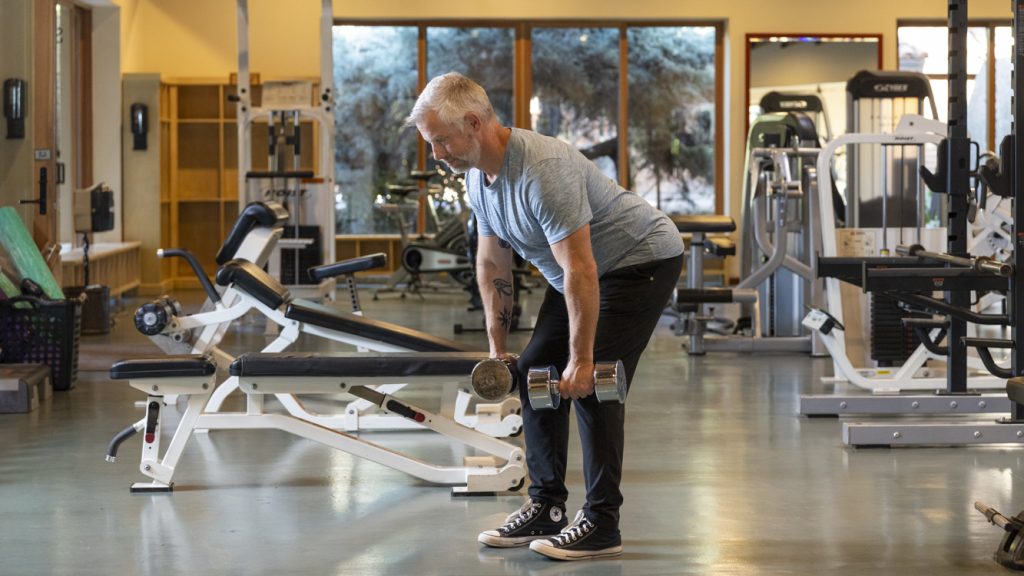
The foundation of strong, resilient movement
The first movement in the workout is the hip hinge, one of the most important patterns for longevity.
This exercise strengthens the hips, glutes, and legs while teaching the body how to bend and lift safely. It’s the movement behind picking something up off the floor, lifting groceries, or standing up with control.
Pete coaches this exercise slowly and intentionally, focusing on sending the hips back and letting the lower body, specifically the gluteus maximus, adductor and hamstring muscles, do the work — not the lower back.
Why Pete includes it:
Strong hips and glutes support balance, posture, and power, all of which are essential for long-term mobility and injury prevention.
Strong hips. Safe lifting. Better posture.
- Set your stance
Stand tall with feet hip-width apart, knees soft, chest open. - Send the hips back
Push your hips back as if closing a car door with them, keeping your spine long and your chest lifted. - Stand up with control
Press through your heels and squeeze your glutes to return to standing.
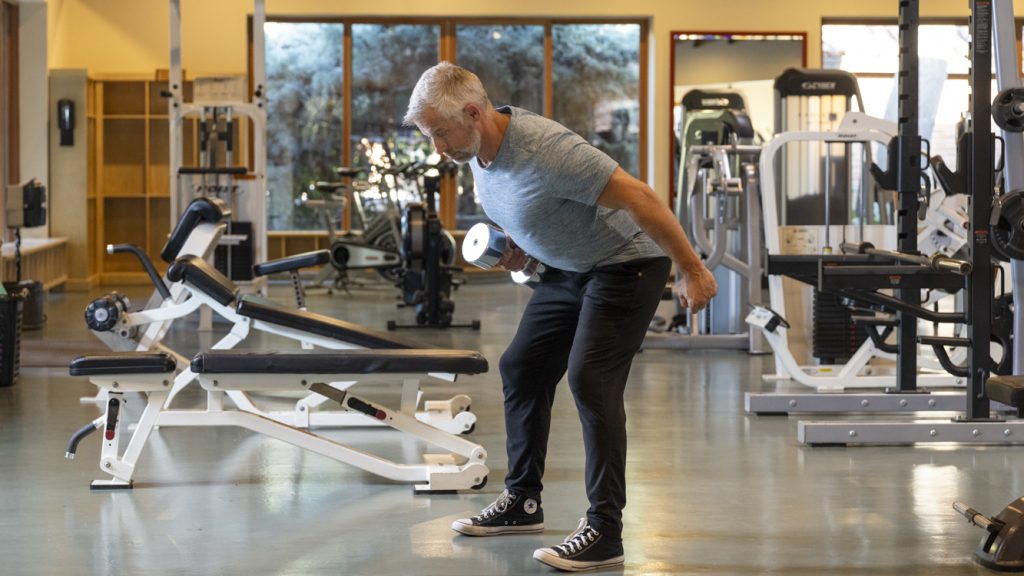
Exercise 2: The One-Arm Row
Back strength with built-in core stability
The second exercise is the one-arm row, which builds back strength while also challenging coordination and stability.
By working one side at a time, this movement engages the core and helps correct imbalances between the left and right sides of the body. Pete emphasizes controlled pulling and lowering — no rushing, no momentum.
Why Pete includes it:
A strong back supports posture, balance, and the ability to carry and lift objects safely, all while reinforcing core stability.
Back strength with built-in core stability.
- Brace and hinge
Hold a dumbbell in one hand, hinge slightly at the hips, and support yourself with the other hand or keep it free for balance. - Pull with your back
Draw the weight toward your rib cage, keeping your elbow close to your body and shoulders relaxed. - Lower slowly
Control the weight back down, maintaining a steady torso and engaged core.
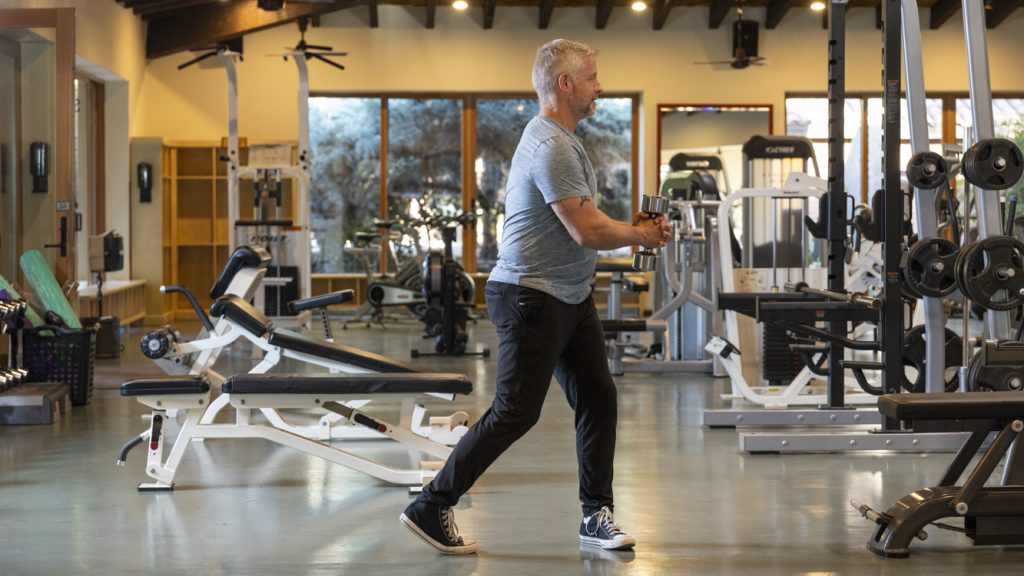
Exercise 3: The Standing Twist
Glute and hip strength through rotation
The final movement is a standing twist, focused on glute and hip strength with rotational control.
Rotation is part of daily life — turning, reaching, changing direction — yet it’s often overlooked in traditional strength training. This exercise teaches the body how to rotate smoothly while staying stable through the hips and core.
Pete encourages slow, deliberate movement here, keeping the lower body engaged and the motion controlled.
Why Pete includes it:
Strong hips and controlled rotation help reduce injury risk and support confident, fluid movement in everyday activities.
Controlled rotation for hips and core.
- Ground your stance
Stand tall with feet shoulder-width apart, weight evenly distributed. - Rotate with control
Turn through your torso and hips together, keeping your spine tall and movement smooth. - Return and reset
Slowly rotate back to center, then repeat to the other side.
How Often Should You Strength Train?
Pete keeps the recommendation simple and sustainable:
- 2–3 sets per exercise
- 2–3 times per week
That’s enough to build strength and muscle without overloading the body. Consistency matters more than intensity.
Why Strength Training Is Essential for Longevity
One of Pete’s key messages in class is this:
Muscle is your organ of longevity.
Muscle helps metabolize carbohydrates into usable energy and plays a major role in long-term metabolic health. In fact, muscle is one of the only tissues in the body — along with the liver — that does this efficiently.
The more muscle you maintain, the better your body becomes at producing and using energy. And strength training is the most efficient way to build and preserve muscle as we age.
Train With Pete at Rancho La Puerta
You can read about these movements — but experiencing them, guided by expert instruction in a supportive environment, makes all the difference.
Strength Training for Longevity, taught by Pete McCall at Rancho La Puerta, helps guests:
- Learn functional, repeatable movements
- Build strength safely and effectively
- Gain confidence they can carry home with them
Come move better.
Come get stronger.
Come experience longevity in action.
Visit us at Rancho La Puerta and join a Strength Training for Longevity class.
Pete McCall, MS, CSCS, is a nationally recognized fitness educator on staff at Rancho La Puerta, an author, and strength coach with decades of experience in the health and wellness industry. He holds a master’s degree in exercise science and health promotion and is a Certified Strength and Conditioning Specialist through the NSCA.
He is also the author of Ageless Intensity, Smarter Recovery, and Smarter Workouts, and has been featured as an expert in The New York Times, The Washington Post, Los Angeles Times, Runner’s World, and SELF. He currently teaches Strength Training for Longevity at Rancho La Puerta, helping guests build strength, resilience, and confidence for long-term health.